


Posted on July 15, 2026 by Ali Bolourchi · ~7 min read
On July 15, 2026, the Bank of Canada did something that's starting to feel routine: nothing. It left the overnight rate unchanged at 2.25%, the sixth straight hold.
For anyone with a mortgage, a home to sell, or a purchase on the horizon, that "no news" is the news. It tells you where borrowing costs are headed for the rest of the year, and it clears out a lot of the uncertainty that has hung over the market for two years.
Here's what they decided, why, and what it actually means for you.
The decision in one line
The policy rate stays at 2.25%. That's the rate that sets the prime rate at the big banks, which drives variable mortgages, HELOCs, and most floating-rate debt.
When the Bank holds, your variable costs hold too. Nothing about your payment, pre-approval, or carrying costs changes because of this announcement.
The real story is the streak. One hold means little. The pattern tells you where we are in the cycle.
How we got here
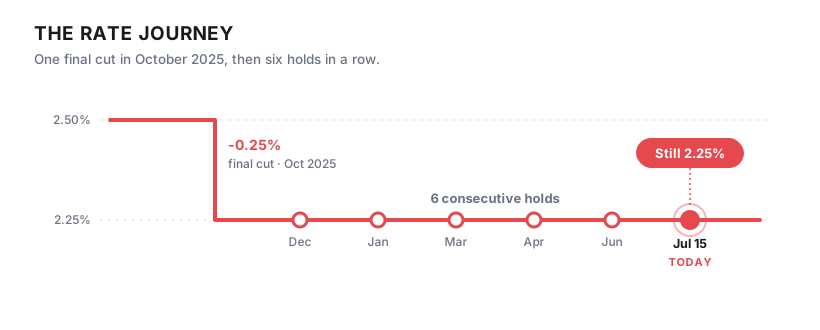
Rewind to last year. Through 2024 and into 2025, the Bank ran an aggressive easing campaign, cutting rates to prop up a slowing economy. That campaign ended in October 2025, with a final quarter-point cut from 2.50% to 2.25%.
Since then, it has been pause mode: holds in December 2025, January, March, April, June, and now July. Six decisions, zero changes. The cutting cycle is over for now, and the Bank wants hard evidence before it moves again either way.
Why they held again
If the economy is soft, why not keep cutting? Because the Bank is boxed in between two opposing forces, and holding buys time while the picture clears.
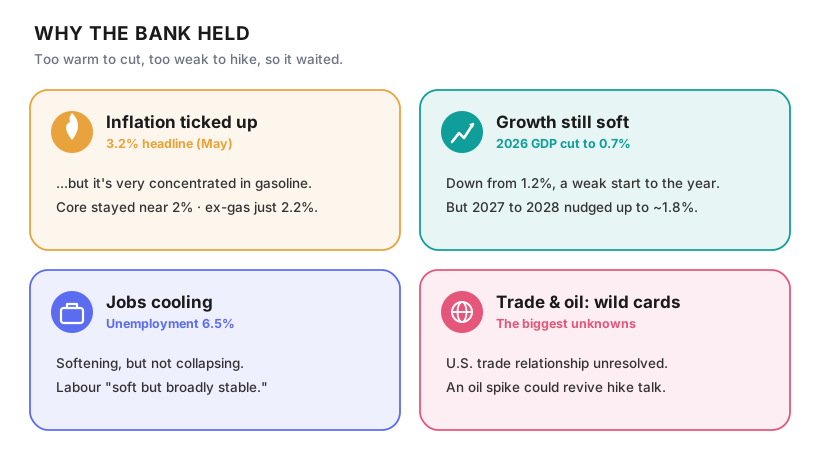
Inflation ticked up. Headline inflation hit 3.2% in May, just above the top of the 1% to 3% range. But Governor Tiff Macklem was blunt that the spike is narrow, not broad: "inflation is very concentrated in gasoline prices." Strip out gas and CPI was rising just 2.2%, while core stayed near 2%.
Growth is still soft, but stabilizing. The Bank cut its 2026 growth forecast to 0.7% (down from 1.2%), while nudging 2027 to 2028 up to about 1.8%. Sluggish now, better later, which takes the urgency out of cutting.
Jobs are cooling, not collapsing. Unemployment sits at 6.5%, and the Bank called labour conditions "soft but broadly stable." Softening usually argues for lower rates, but "stable" is the key word. There's no crisis forcing its hand.
Trade and oil are the wild cards. The two biggest risks are the unresolved Canada and U.S. trade relationship and Middle East tension that could push oil higher. Macklem warned that "if oil prices go higher and stay higher," inflation risks would broaden, and he refused to rule out hikes if energy costs spike, though that is "not our base case."
The message in plain terms: too warm to cut, too weak to hike, too foggy to bet either way. So the Bank waits.
What it means for you
A hold isn't neutral. It lands differently depending on which side of the market you're on.
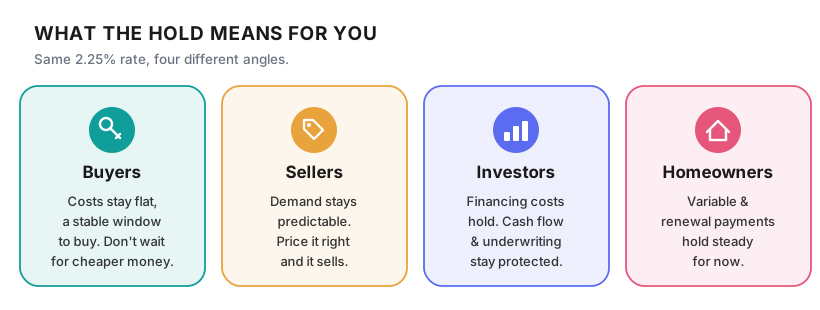
Buyers. Stability is your friend. Variable rates won't rise off this decision, and fixed rates (driven more by bond markets than the overnight rate) have settled into a predictable range. That's a stable window to shop, get pre-approved, and know your payment before you commit. The trade-off: don't wait around for dramatically cheaper money. With the Bank on a long pause, "holding out for lower rates" costs you time and pays for rising prices. If the numbers work today, they'll likely keep working.
Sellers. Predictable rates keep the buyer pool predictable. When costs stop lurching around, buyers regain confidence and commit, because they can budget with certainty. But this isn't an ultra-low-rate frenzy. Demand is steady, not red-hot, so pricing discipline matters. Well-presented, well-priced homes sell. Overpriced listings sit and go stale.
Investors. Flat financing costs are a gift for underwriting. With the Bank on an extended pause, you can model your payments with confidence, protect your cash-flow projections, and move on deals without fear of a surprise rate jump erasing your margin. Stable rates also keep cap rates steady, so you can compare opportunities on fundamentals instead of guessing where financing lands.
Homeowners. It depends on your mortgage. Variable-rate holders and anyone facing a renewal get steady payments for now, a welcome break after recent volatility. Fixed-rate holders see no change until renewal, and even then today's fixed rates are far easier to live with than the peaks of the tightening cycle. If your renewal is close, shop around rather than signing your lender's first offer, which is rarely their best one.
What to watch next
The next decision is September 2, 2026. Three things will shape it.
First, inflation. If the gas-driven spike fades and headline drifts back toward 2%, it cracks the door open for a future cut. Second, trade. Any shift in the Canada and U.S. relationship could move growth forecasts sharply. Third, oil. A sustained jump in energy prices is the one scenario that could genuinely put hikes back on the table, so watch the pumps.
For now, the base case is more of the same. Most economists expect 2.25% to hold well into 2027, with any eventual move more likely a modest cut than a hike.
The bottom line
Six meetings in, the message is clear: we've entered a stretch of genuine rate stability. The big cuts are behind us, hikes are unlikely, and the Bank is content to watch and wait. For real estate, that's the most workable backdrop there is. Not the euphoria of falling rates, but the certainty that lets everyone plan.
Stability rewards action. If you've been on the sidelines waiting for a signal, this is it: the ground has stopped moving.
Before you make a move
Whether you're buying your first home, listing a property, adding to a portfolio, or facing a renewal, let's build a plan around numbers you can actually count on. No pressure and no upsell, just an honest read on what this market means for your situation.
Reach out anytime and we'll map out your next step.
%20Trans.png)
Comments:
Post Your Comment: